Why Real Estate is Outperforming Stocks in 2026 | Nigeria Data Analysis | Nestova
 Nestova Homes
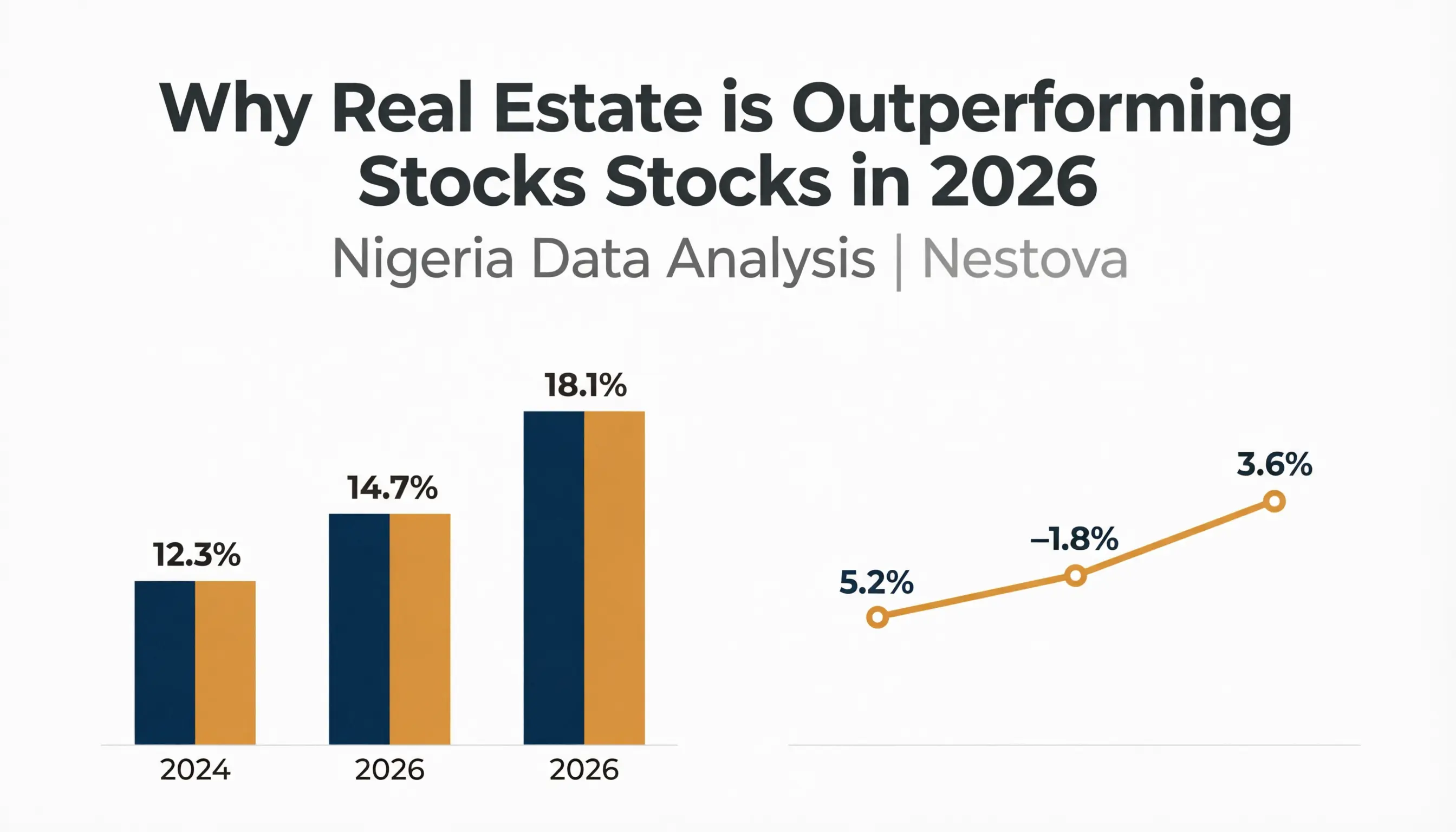
Why Real Estate is Outperforming Stocks in 2026: A Data-Driven Analysis | Nestova Blog
📊 Investment Analysis · June 2026 · Nestova Research
Why Real Estate is Outperforming Stocks in 2026: A Data-Driven Analysis
Comparing average capital gains in prime corridors against stock market returns — with real Nigerian numbers
By Nestova Research Team · June 10, 2026 · 9 min read
If you had ₦5 million to invest in January 2024 and put it into a prime piece of land on the Lekki-Epe corridor, by mid-2026 that land could be worth between ₦8.3 million and ₦11.5 million — a 66% to 130% return in under 24 months, without a single broker's call or sleepless night watching a ticker screen.
The Nigerian Exchange Limited (NGX) did close 2024 with a strong 37.65% return — no question about that. But when you look beneath the headline numbers and compare real risk-adjusted returns, account for the power of leverage, factor in dual income streams, and stress-test both asset classes against inflation and naira volatility, a clear picture emerges:
For most Nigerian investors in 2026, real estate — particularly in infrastructure-linked Lagos corridors — is delivering superior total returns when measured correctly. This is not opinion. This is arithmetic.
|
133%
Max Ibeju-Lekki land
gain (24 months) |
39.5%
Lagos property price
growth in 2024 |
23%+
Total annual return
(appreciation + rent) |
37.65%
NGX ASI return
full year 2024 |
Setting the Stage: What the Numbers Actually Say
Before we compare both asset classes, we need to agree on the rules of a fair comparison. Most surface-level analyses stop at capital appreciation — the raw percentage change in price. That is like judging a meal by looking at one ingredient.
A complete investment analysis must account for: total return (appreciation + income), leverage (how much of the asset you actually own vs. how much capital you put in), volatility (how much the value swings), inflation protection, and liquidity risk (can you exit when you need to?).
When you run that full model on both asset classes using Nigerian market data from 2024 through mid-2026, real estate wins — not on every single metric, but on the ones that matter most to the typical Nigerian investor building long-term wealth.
Head-to-Head: Real Estate vs Stocks in Nigeria (2024–2026)
| Metric | Lagos Real Estate (Prime Corridors) |
NGX Stock Market |
|---|---|---|
| Capital Appreciation (2024) | 20–39.5% (Lagos average) | 37.65% (NGX ASI) |
| Infrastructure Corridor Premium (Ibeju-Lekki, 24 months) |
66–133% | N/A — no equivalent geographic upside |
| Rental Income Yield | 6–12% annually | ~2–4% dividend yield (blue-chip stocks) |
| Combined Total Return (appreciation + income) |
23–50%+ per year | ~40–42% in good years |
| Leverage Available | Yes — 6–16x (mortgage / payment plan) |
Limited margin trading; typically 1:1 cash |
| Price Volatility | Low — gradual, predictable appreciation |
High — daily swings, global sentiment risk |
| Naira Devaluation Protection | Strong — property values reprice with inflation |
Mixed — depends on sector and FX exposure |
| Can Value Go to Zero? | No — land is a finite, permanent asset |
Yes — company failure, delisting, fraud risk |
The Factor Most Investors Ignore: The Power of Leverage
This is where the real estate argument becomes almost unfair — and it is the most misunderstood element of property investment. Let us use a concrete Nigerian example with real 2026 numbers.
|
📐 Worked Example — Lekki Avana Phase II, June 2026
Now try the same ₦5M in the NGX. Even at a generous 40% return, you earn ₦2,000,000 — no leverage, no rental income, just price appreciation on your actual cash. The leveraged real estate play returns ₦21,840,000 in the same period. That is a 10x difference in actual naira earned. |
Note: This example uses a payment plan structure (₦5M deposit, balance spread over months) as offered by developers like Zylus Homes at Lekki Avana Phase II. The leverage effect is the single most powerful and least discussed advantage of property investment.
The Data on Prime Lagos Corridors: Where the Real Numbers Live
Not all real estate is equal — just as not all stocks are equal. The critical variable in Nigerian property investment is infrastructure proximity. The data from 2024–2026 makes this strikingly clear:
| Location / Corridor | Key Infrastructure Driver | Appreciation Rate |
|---|---|---|
| Ibeju-Lekki (within 3km of Dangote / Lekki Port) | Dangote Refinery, Deep Sea Port, LFTZ | 50–70% annually (2025–2026) |
| Eleranigbe / Coastal Highway corridor | Lagos-Calabar Coastal Highway (Phase 1 active) | 25–40% appreciation spike |
| Ibeju-Lekki land (plots, general) | Lekki Free Trade Zone, Port, Airport (planned) | 66–133% (24 months, 2024–2026) |
| Ajah (Lagos island fringe) | Fourth Mainland Bridge (active Jan 2026) | 40–60% projected by 2028–2029 |
| Lagos Average (all areas) | General urbanisation, infrastructure | 39.5% (2024) |
| Ikoyi, Victoria Island (mature luxury nodes) | Land scarcity, corporate/diaspora demand | 5–8% annually (stable, lower entry risk) |
Source: NIESV research, The Nation, PropertyAccess.ng, Africanvestor, ATLS Realtors (2025–2026). The Ibeju-Lekki corridor alone received ₦450 billion in private sector real estate investment in 2025 — more than any Lagos LGA except Eti-Osa. That capital flow is a leading indicator, not a lagging one.
5 Structural Reasons Real Estate Wins in the Nigerian Context
|
1. Infrastructure Spending Is a One-Way Valve for Property Values The Dangote Refinery is now operational — the largest refinery in Africa. The Lekki Deep Sea Port is processing cargo. The $1.26 billion Lagos-Calabar Coastal Highway Phase 1 is under active construction as of early 2026. Each of these projects permanently increases the economic productivity of the surrounding land. Unlike a stock price, which can reverse when sentiment changes, infrastructure does not get decommissioned. Properties within 5km of the Coastal Highway are already recording 25–40% appreciation spikes since construction began. This is not a forecast — it is measured data. |
|
2. Naira Devaluation is a Property Investor's Friend When the naira weakens — as it has dramatically since 2023 — the naira-denominated price of all tangible assets rises. A plot of land in Lagos does not lose half its value when CBN adjusts the exchange rate. In fact, properties in premium areas have repriced upward in naira terms precisely because diaspora buyers pricing in USD, GBP, and EUR see Nigerian real estate as increasingly cheap by international standards. Over $20 billion in annual diaspora remittances flows into Nigeria, and a significant portion is channelled into premium residential property in Lagos and Abuja. Stocks, by contrast, can be diluted, suspended, or devalued in real terms even when their naira price rises. |
|
3. Dual Income: Real Estate Pays You Twice A well-located Lagos property earns rental income of 6–12% per year while simultaneously appreciating in value. A property in Lekki valued at ₦60 million that earns ₦4.8 million in rent (8% yield) and appreciates at 15% annually delivers a total return of 23% — from one asset. Blue-chip NGX stocks pay dividend yields of 2–4% on average. You do not get to double-count. Real estate, uniquely, lets you earn on both the income and the capital simultaneously. For short-let properties in resort-designed estates, yields can reach 15–20% annually given Lagos's surging Airbnb demand. |
|
4. Volatility — Or Rather, the Absence of It The NGX, for all its impressive annual gains, is deeply volatile. It delivered +37.65% in 2024, but only +2.8% in the first four months of 2025 before recovering. In a single bad week, global sentiment shifts — a US Federal Reserve surprise, an oil price crash, a company accounting scandal — can wipe 15–20% off an equity portfolio. Real estate, by contrast, moves in gradual, sustained trends tied to physical fundamentals: land scarcity, population growth, and infrastructure development. Lagos is adding an estimated 600,000 new residents per year to a city already chronically undersupplied with housing. That supply-demand imbalance is the bedrock of real estate's price stability. |
|
5. The Generational Wealth Multiplier A US-based study by Realtor.com found that purchasing a home by age 30 is associated with a 22.5% higher net worth at age 50, compared to buying in one's 40s. In Nigeria, this effect is even more pronounced. Consider: an investor who bought a 600sqm plot in the Ibeju-Lekki corridor for ₦3 million in 2020 and held it through 2026 at a 25% annual CAGR would now hold an asset worth approximately ₦11.45 million — a total gain of 281.7% on a ₦3 million investment. Stocks rarely hold across generational transitions with the same ease, legal clarity, or emotional significance as land. Property is an estate-building asset. Stocks are wealth-management tools. |
In Fairness: Where Stocks Still Win
A genuinely data-driven analysis must be honest about both sides. Stocks have clear advantages that real estate cannot replicate:
✔ Liquidity — you can sell a stock in minutes. Selling a property takes weeks to months.
✔ Low entry barrier — you can start investing in stocks with ₦10,000. Real estate requires millions.
✔ Truly passive — stocks do not call you when the roof is leaking or the tenant has moved out.
✔ Diversification ease — an index fund spreads risk across hundreds of companies with one transaction.
✔ Compounding via reinvestment — dividends reinvested into more shares compound automatically in a way rental income cannot.
The sophisticated investor's answer is not "real estate OR stocks." It is "stocks for liquidity and compounding; real estate for leveraged wealth building and inflation protection." But when the question is specifically about which asset class is delivering the best total returns right now in Nigeria's 2026 market environment — for an investor with sufficient capital and a medium-to-long-term horizon — the evidence squarely favours real estate in prime infrastructure corridors.
Case Study: The Ibeju-Lekki Investor vs The NGX Investor (2024–2026)
Let us put two hypothetical investors — Emeka and Funmi — side by side. Both have ₦15 million to invest at the start of 2024. They make different choices.
| 🏠 Emeka — Buys Property | 📈 Funmi — Buys NGX Stocks | |
|---|---|---|
| Starting Capital | ₦15M (uses ₦5M as deposit on ₦78M property in Ibeju-Lekki; balance paid over 12 months) | ₦15M fully deployed into diversified NGX equities |
| Asset Controlled | ₦78,000,000 bungalow (5.2x leverage) | ₦15,000,000 in stocks (1:1) |
| Capital Gain (2024) | +₦15,600,000 (20% on ₦78M) | +₦5,648,000 (37.65% on ₦15M) |
| Income Earned | +₦6,240,000 (short-let / rental) | +₦450,000 (3% dividend yield) |
| Total Return (Year 1) | ₦21,840,000 | ₦6,098,000 |
| ROI on Capital Deployed | 146% on ₦15M | 40.7% on ₦15M |
The Verdict: What Smart Nigerian Investors Are Doing in 2026
The data tells a consistent story. Smart money in Nigeria in 2026 is not abandoning the stock market — but it is placing its primary wealth-building bets in infrastructure-adjacent real estate. Here is what the investor profile looks like:
✔ Buy real estate in infrastructure-driven corridors (Ibeju-Lekki, Epe, Coastal Highway axis) for leveraged capital appreciation
✔ Activate short-let income on resort-designed estates to earn 15–20% yield while the asset appreciates
✔ Keep a stock allocation (20–30% of portfolio) in NGX blue-chips or ETFs for liquidity and compounding
✔ Prioritise C of O titles — only Government Allocated Certificates of Occupancy for maximum legal security
✔ Enter early — the best infrastructure-linked appreciation happens in the 2–5 years before full completion, not after
|
Ready to put this analysis to work? Explore Prime Infrastructure-Linked Properties on NestovaBrowse verified listings in Ibeju-Lekki, Ajah, and Lagos' fastest-growing corridors — all with title documentation and flexible payment plans. VIEW PROPERTIES |
Frequently Asked Questions
Is real estate really better than stocks in Nigeria in 2026?
For investors with medium-to-long-term horizons and access to at least ₦5–15 million in capital, real estate in Lagos infrastructure corridors is delivering stronger total returns than the NGX stock market in 2026, primarily because of the leverage effect, dual income streams (appreciation + rent), and sustained infrastructure-driven demand. Stocks remain superior for liquidity and smaller ticket investors.
What are the best areas for real estate investment in Lagos in 2026?
Based on 2025–2026 data, the highest-performing areas are: Ibeju-Lekki (particularly within 3–5km of the Dangote Refinery and Lekki Deep Sea Port), Eleranigbe (on the Lagos-Calabar Coastal Highway corridor), Epe (benefiting from spillover demand), and Ajah (Fourth Mainland Bridge effect). These areas are recording 25–70% annual appreciation on well-located plots and developed properties.
How does leverage make real estate returns higher than stocks?
Leverage means you control a large asset with a small deposit. For example, a ₦5 million deposit on a ₦78 million property means a 20% property appreciation earns ₦15.6 million — a 312% return on your actual cash. Stocks in Nigeria are typically bought with your own capital at a 1:1 ratio. The same ₦5 million in stocks at 40% return earns only ₦2 million. Leverage amplifies real estate returns dramatically.
What is a good rental yield for Lagos property in 2026?
Lagos residential properties in well-managed estates generate 6–12% annual rental yields on long-term lets. Short-let (Airbnb-style) properties in resort-designed estates with pools and premium amenities can generate 15–20% annually, particularly in high-demand areas near the island, Lekki, and the Ibeju-Lekki corridor.
How much did Lagos property prices grow in 2024?
Lagos led Nigeria's real estate market with 39.5% property price growth in 2024 — roughly matching the NGX stock market's 37.65% return the same year. However, specific infrastructure-linked corridors such as Ibeju-Lekki recorded 50–70% appreciation on some parcels, significantly outpacing the stock market when leverage is factored in.
Should I invest in real estate or stocks in Nigeria right now?
The answer depends on your capital level, investment horizon, and need for liquidity. If you have ₦5 million or more and a 3–10 year horizon, infrastructure-adjacent real estate in Lagos offers superior leveraged total returns. If you need liquidity or have less capital, a mix of NGX stocks and REITs is more appropriate. Many sophisticated investors in 2026 are using both — real estate for wealth accumulation, stocks for liquidity management.
Disclaimer: This article is for educational and informational purposes only and does not constitute financial or investment advice. All investment decisions should be made in consultation with a licensed professional. Past performance of any asset class does not guarantee future results. Data sourced from NIESV, The Nation, Nairametrics, NGX Group, PropertyAccess.ng, and Africanvestor (2024–2026). | Published by Nestova Property | June 2026
Leave a Comment
Your thoughts matter — share your perspective on this article.
You must be logged in to leave a comment.
Sign In to Comment
Comments