The Complete Guide to Land Titles in Nigeria: C of O, R of O, Gazette, and Deed of Assignment Explained
 Nestova Homes
✦ Nestova Property Guide · Nigerian Real Estate Education Series
The Complete Guide to Land Titles in Nigeria: C of O, R of O, Gazette, and Deed of Assignment Explained
What Every Buyer, Investor, and Diaspora Nigerian Must Know Before Paying a Kobo for Any Property
Why Land Titles Matter More Than the Price of the Land
Every year, thousands of Nigerians lose their hard-earned money to land fraud, government demolitions, and ownership disputes — not because they were careless, but because they did not understand the one thing that determines whether their land is truly theirs: the title document.
Whether you are buying land in Lagos, Abuja, Asaba, or Ibadan — whether you are a first-time buyer, a seasoned investor, or a Nigerian in the diaspora sending money home — the type of title on a piece of land determines its legal safety, its value, its mortgageability, and your ability to resell or develop it without interference.
Yet most Nigerians walk into land transactions only knowing one phrase: "make sure it has C of O." That is a start — but it is far from the whole picture. In this guide, Nestova breaks down every major land title and property document in Nigeria: what each one means, how strong it is, when you need it, and what happens if you buy land without it.
|
1978
Land Use Act Enacted
|
99 Yrs
Max Occupancy Term
|
3–5%
Governor's Consent Fee
|
36
States + FCT Covered
|
First, Understand This: Nobody “Owns” Land in Nigeria Absolutely
Before we explain each title, there is one foundational truth every Nigerian buyer must internalize. Under the Land Use Act of 1978 — Nigeria's principal land law — all land in every state is legally vested in the Governor of that state, who holds it in trust for the people.
This means that when you “buy” land in Nigeria, what you are actually acquiring is a Right of Occupancy — the legal right to use, develop, and enjoy the land — not absolute ownership in the international sense. The government retains the ultimate title. This single fact explains why documents like Governor's Consent, C of O, and R of O exist and why they matter so profoundly.
|
⚠️ The Most Important Rule in Nigerian Real Estate Under Section 22 of the Land Use Act, any transfer, sale, mortgage, or assignment of land without the Governor's Consent is legally void and unenforceable. You may have paid in full, moved in, and built a fence — but without the right documents perfected, the law does not recognize you as the owner. |
1. Certificate of Occupancy (C of O) — The Gold Standard
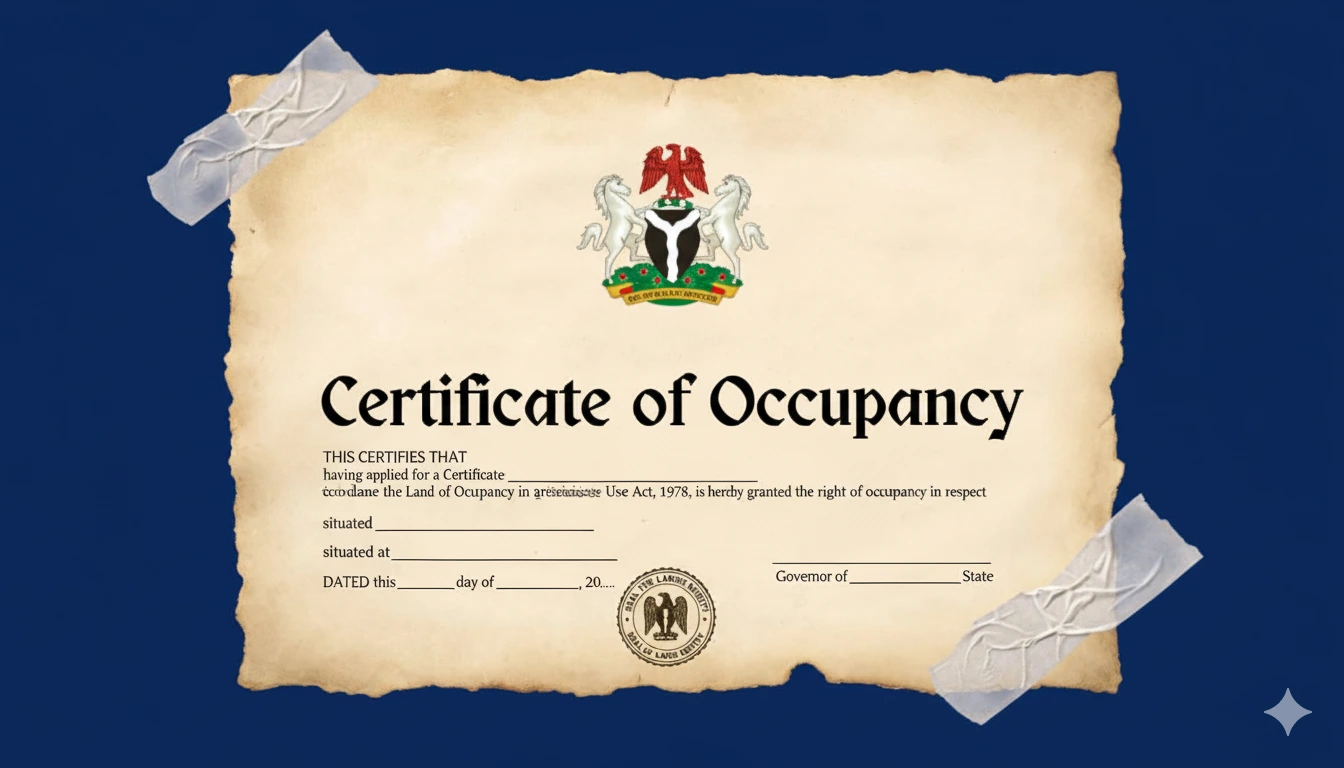
The Certificate of Occupancy, commonly called C of O, is the highest and most bankable land title in Nigeria. It is a legal document issued directly by the State Governor (through the Ministry of Lands) that formally grants an individual, company, or organization the right to occupy and use a specific piece of land for a term not exceeding 99 years, subject to renewal.
The C of O was introduced under the Land Use Act of 1978 to unify Nigeria's fragmented land tenure system and create a single, government-backed proof of land rights. It is issued only once — to the first person to receive a formal grant on virgin government land — which makes it the cleanest possible title you can hold.
What Makes C of O the Strongest Title?
| ✅ Bank & Mortgage Accepted — Banks will accept C of O as collateral for loans. It is the only title that unlocks mortgage financing in Nigeria. |
| ✅ Government Protected — A C of O holder cannot be ejected or demolished without due process and compensation under the law. |
| ✅ Easy Resale — Property with a C of O attracts more buyers, commands premium prices, and transfers faster with fewer legal complications. |
| ✅ Prevents Double Sales — Because it is registered, a C of O prevents the same land from being fraudulently sold to multiple buyers simultaneously. |
| ✅ Government Allocation Projects — All government-allocated estates (like Lekki Avana Phase II) carry a C of O, the strongest possible backing for your investment. |
How to Obtain a C of O
To obtain a C of O, you apply through your State Ministry of Lands with a formal application, survey plan, tax clearance, and prescribed fees. The government inspects the land, and if approved, issues the certificate registered in the Land Registry. Processing timelines vary by state — in Lagos, for example, it can take between six months to two years depending on the application route and whether the land is already in the government allocation system.
Important note for buyers: When a developer says their estate has a “C of O,” ask whether it is a Global C of O (covering the entire estate land) or individual C of Os per plot. Both are valid, but individual C of Os per buyer are stronger and take more time to process after purchase.
2. Right of Occupancy (R of O) — The Parent of All Land Rights
The Right of Occupancy is not a separate physical document like the C of O — rather, it is the legal concept that underlies all land rights in Nigeria under the Land Use Act. Every land title in Nigeria, at its core, is a form of Right of Occupancy. Understanding this distinction is key to understanding why every document you acquire matters.
There are two types of Right of Occupancy:
|
📍 Statutory Right of Occupancy Granted by the State Governor for land in urban areas. Evidenced by a Certificate of Occupancy. This is what most buyers in Lagos, Abuja, and major cities deal with. It grants the holder exclusive possession against everyone — except the Governor himself — for up to 99 years. |
📍 Customary Right of Occupancy Granted by the Local Government Authority for land in rural, non-urban areas. It governs land still managed under community and family ownership systems. This type of right is less formalized and is often what underlies Gazette and Excision titles before they are upgraded. |
In everyday real estate practice, when an agent or developer mentions “R of O,” they are typically referring to a Right of Occupancy document issued by a state government as a precursor to a full C of O — sometimes called a Letter of Allocation or Right of Occupancy Letter. This is a valid but intermediate title. It acknowledges your right to occupy the land but has not yet been converted to a full Certificate of Occupancy.
|
💡 Practical Advice on R of O If you are buying land with an R of O title, ensure you confirm it is registered with the state's land bureau and that there is a clear pathway to converting it to a full C of O. An unregistered R of O offers minimal legal protection. |
3. Excision and Gazette — The Community Land Release Process
This is the title combination that confuses buyers the most — and understanding it correctly could save you from buying land that is still technically inside government acquisition.
What Is Excision?
Excision is the official process by which the government releases — or “excises” — a portion of land from a previously acquired government area and returns it to the original community or family that owned it. In states like Lagos, the government acquired vast swathes of land decades ago for public development. Many of those areas were never developed, and communities petitioned the government to have portions released back to them. When the government approves this request, the process is called an excision.
What Is a Gazette?
Once excision is approved, the details of the land released — its boundaries, measurements, and the community it belongs to — are published in the official government Gazette. This publication is the legal proof that the excision has been formally completed and that the land is now free from government acquisition.
There cannot be a valid Gazette without a completed Excision. They work together as one process: Excision is the action; the Gazette is the official public record of that action.
| 📝 How the Excision → Gazette Process Works | |
| 1 | Community petitions the state government to release their ancestral land from government acquisition |
| 2 | Government surveys the land, confirms it is not needed for public use, and approves the release |
| 3 | The approved excision details are published in the official State or Federal Government Gazette |
| 4 | The community can now sell plots within the excised area — and buyers can use the Gazette as title evidence and later process a C of O from it |
Is Gazetted Land Safe to Buy?
Yes — a properly gazetted land is safe. It is free from government acquisition and the community has the legal right to sell within the excised boundaries. The family or community head of that land has the authority to sign the purchase documents. After buying gazetted land, the buyer can then apply for a C of O to upgrade their title to the highest level.
The risk arises when sellers claim land is “excised” but cannot produce the actual Gazette document. Always demand to see the physical Gazette publication and cross-check it with the Surveyor-General's office before buying.
4. Deed of Assignment — The Transfer Document
A Deed of Assignment is the legal document that records the transfer of ownership rights in land or property from one person (the Assignor) to another (the Assignee). When you buy land from a private individual rather than directly from the government, the primary document exchanged is a Deed of Assignment.
Think of the Deed of Assignment as the “sales agreement plus transfer proof” — it confirms that the seller has assigned all their rights, title, and interest in the property to the buyer, at an agreed price, on a specified date.
What a Valid Deed of Assignment Must Contain
| 📋 Full legal names and addresses of both buyer and seller |
| 📋 Precise description and survey details of the land being transferred |
| 📋 The agreed purchase price and full payment confirmation |
| 📋 The date of the transaction and the effective date of transfer |
| 📋 Signatures of both parties, witnessed and signed by at least two witnesses |
| 📋 The document must be stamped by the State Inland Revenue Service (stamp duty) and registered at the Land Registry for full legal validity |
The Critical Limitation of a Deed of Assignment Alone
Here is where most buyers make a costly mistake: a Deed of Assignment alone does not complete your ownership. Under the Land Use Act, any transaction involving land that carries a C of O is legally void until the Governor's Consent is obtained and the assignment is registered. Without perfecting the title with Governor's Consent, the original seller technically remains the recognized owner in the eyes of the law — and could sell the same land again.
5. Governor's Consent — The Step Most Buyers Skip (At Their Peril)
Governor's Consent is the official approval from the State Governor — issued through the Ministry of Lands — for the transfer of land rights from one party to another. It is required by law under Section 22 of the Land Use Act for any assignment, mortgage, sublease, or transfer of a statutory Right of Occupancy.
Simply put: if you buy land with a C of O from someone who is not the government, you must obtain the Governor's Consent to “perfect” your title. Without it, the transaction is legally incomplete — regardless of how much you paid or how long you have lived on the land.
|
🚨 What Happens If You Skip Governor's Consent? ✗ Your ownership is not legally recognized by the government ✗ No bank will accept the property as mortgage collateral ✗ The original seller could fraudulently sell the land to another buyer who obtains consent first — and legally win ✗ Your heirs cannot inherit the land without further legal complications ✗ In the event of government acquisition, you may receive no compensation |
Governor's Consent fees typically range from 3% to 5% of the property value, depending on the state. In Lagos, the process involves submitting the Deed of Assignment, survey plan, tax clearance, and paying the required fees. Processing can take several months. Many buyers delay this step to avoid the cost — but the legal and financial risks of doing so far outweigh the fees.
6. Survey Plan — The Map That Defines Your Land
A Survey Plan is a technical drawing prepared by a licensed surveyor that maps out the exact dimensions, coordinates, boundaries, and location of a piece of land. It is not a title document in itself, but it is a required companion to every title document in Nigeria — without it, no C of O can be processed, no Deed of Assignment can be properly executed, and no Land Registry registration can be completed.
The survey plan also serves a critical investigative function: it reveals whether the land falls within a government acquisition area, whether it has an existing title, and whether it overlaps with any other registered property. Always insist that your surveyor submits the plan to the Surveyor-General's office for verification before you complete any purchase.
Title Strength Comparison: Which Is the Safest?
Here is a plain-English comparison of all major Nigerian land titles ranked by legal strength and practical safety:
| Title / Document | Strength | Bank Accepted? | Upgradeable? |
|---|---|---|---|
| C of O (Govt. Allocated) | ⭐ Highest | ✅ Yes | N/A — Already top |
| C of O (Private / Converted) | Very High | ✅ Yes | N/A |
| Gazette (Excised Land) | High | 🔴 Some banks | ✅ To C of O |
| Deed of Assignment + Gov. Consent | High (when perfected) | ✅ When registered | ✅ Yes |
| Right of Occupancy (R of O) | Medium | 🔴 Rarely | ✅ To C of O |
| Deed of Assignment (No Gov. Consent) | Low (incomplete) | ❌ No | ✅ Must perfect first |
| Receipt / Agreement Only | 🔴 Very Risky | ❌ No | ❌ Not a title |
7 Red Flags That Should Stop Any Land Purchase Immediately
| 🔴 1. Seller Cannot Produce the Original Title Document Photocopies are not enough. Always insist on seeing — and verifying — the original document. Fraudsters routinely forge or photocopy titles. |
| 🔴 2. The Land Is “Excised” But There Is No Gazette to Show Excision without a published Gazette is a claim, not a title. Always verify excision in the official government gazette at the Land Registry. |
| 🔴 3. Urgent Pressure to Pay Before You Verify Legitimate sellers will always give you time to conduct a proper search. Any pressure to pay “today or lose the land” is a major warning sign. |
| 🔴 4. Multiple People Claiming Ownership of the Same Land Family land disputes are among the most common causes of fraud. If different family members are presenting separate documents for the same land, walk away. |
| 🔴 5. The Survey Plan Shows Government Acquisition If a survey search at the Surveyor-General's office reveals the land is still inside a government acquisition area and has not been excised, do not buy regardless of what the seller says. |
| 🔴 6. No Governor's Consent on an Existing C of O Transfer If you are buying land from a private owner whose title is a C of O, confirm that the transfer was properly consented by the Governor. Without this, the previous sale was void — and so is yours. |
| 🔴 7. Developer Has No Registered Address or Physical Office Always buy from verifiable, registered companies with traceable physical addresses, CAC registration, and a documented track record of delivery. |
How to Verify Any Land Title in Nigeria: Step-by-Step
Before paying any money for land or property in Nigeria, every serious buyer should complete the following verification steps. This is called “perfecting your due diligence” and it is what separates protected investors from fraud victims.
| 🔎 Land Title Verification Checklist | |
| 1 | Conduct a Search at the Land Registry — Submit the title document number to the State Land Registry and request an official search. This confirms whether the title is genuine, whether there are encumbrances, and who the registered owner is. |
| 2 | Submit the Survey Plan to the Surveyor-General's Office — This confirms whether the land is within government acquisition, whether it has been excised or gazetted, and whether it overlaps with other registered land. |
| 3 | Engage a Registered Property Lawyer — Always have a qualified solicitor review all documents before you sign anything or make any payment. The cost of a lawyer is a fraction of what you stand to lose without one. |
| 4 | Physically Inspect the Land — Visit the site personally. Confirm the beacons (survey markers) are intact, the land is not already occupied by someone else, and that the size matches what was represented. |
| 5 | Verify the Seller's Identity — Cross-check the name on the title document against the seller's valid ID. If a company is selling, verify their CAC registration and confirm the signatory is authorized. |
| 6 | After Purchase: Perfect Your Title — Stamp your Deed of Assignment, obtain Governor's Consent, and register at the Land Registry. Do not treat this as optional — it is the step that makes your ownership legally complete. |
What Is Changing: Nigeria's Land Reform Push in 2026
It is important for buyers and investors to note that Nigeria's land administration system is not static. In late 2025, the Federal Government inaugurated Land Reform Task Teams specifically to streamline land administration, reduce bureaucracy around title processing, and explore amendments to the Land Use Act of 1978 — a law widely criticized as the single greatest bottleneck to Nigeria's real estate growth.
Key proposals being debated include making Governor's Consent an automatic administrative process rather than a political one, reducing processing time from years to weeks, and improving compensation for revoked land rights. While significant changes had not yet been enacted as of mid-2026, buyers should stay informed — any reform to land administration will directly affect how titles are processed, how quickly C of Os are issued, and what the true cost of perfecting a title becomes.
|
Need Help Verifying a Title or Finding Secure Property in Nigeria? Nestova Lists Only Verified, Title-Secure Properties Across NigeriaEvery property listed on Nestova has been reviewed for title legitimacy. Whether you are buying for personal use, investment, or as a diaspora Nigerian, our team is here to guide you through the process — safely and transparently. SPEAK TO A NESTOVA EXPERT |
Frequently Asked Questions — Land Titles in Nigeria
What is the difference between a C of O and a Deed of Assignment?
A Certificate of Occupancy is issued by the government and grants the first right to occupy land. A Deed of Assignment is a private legal document that transfers that right from one individual to another. You need both: the C of O establishes the root of title; the Deed of Assignment (with Governor's Consent) records each subsequent transfer.
Can I buy land in Nigeria with only a Deed of Assignment?
Yes, but only if you then perfect the title by obtaining Governor's Consent and registering the deed at the Land Registry. A Deed of Assignment alone — without consent and registration — is legally incomplete and offers you minimal protection.
Is Gazetted land safe to buy?
Yes, provided the Gazette is genuine and the land falls within the officially excised boundaries. Always verify the Gazette at the Surveyor-General's office and conduct a Land Registry search before purchase. After buying, process a C of O to upgrade your title further.
Do I need Governor's Consent every time land is sold?
Yes. Under Section 22 of the Land Use Act, every transfer of a statutory Right of Occupancy — including every resale — requires Governor's Consent. Each time a C of O property changes hands, the new buyer must obtain fresh consent. Failure to do this makes the transaction legally void.
What is the difference between Excision and Gazette?
Excision is the process by which government releases land back to a community. The Gazette is the official government publication that records and confirms that excision. There cannot be a valid Gazette without a completed excision — they are two stages of the same process.
How do I know if land is still under government acquisition?
Submit the survey plan of the land to the Surveyor-General's office in the relevant state and request a search. The results will indicate whether the land has been acquired, excised, or is free and clear. This is one of the most important steps in any land purchase.
Can diaspora Nigerians safely buy land from abroad?
Yes, but additional caution is required. Use only verified, registered real estate companies with a track record of delivery. Insist on seeing all original title documents, commission a lawyer and independent surveyor on the ground, and ensure all documents are perfected — including Governor's Consent — before completing payment.
This guide was published by Nestova Property — Nigeria's trusted real estate marketplace — for educational purposes only and does not constitute legal advice. For specific legal matters relating to land transactions, always consult a qualified Nigerian property lawyer. Information accurate as of May 2026. | Contact Nestova
Category
Comments
Leave a Comment
Your thoughts matter — share your perspective on this article.
You must be logged in to leave a comment.
Sign In to Comment
Educationally Intriguing